Introduction and UNESCO's Mandate
Page 1
Yamousoukro and Seville Statement
Page 2
Origins and Executive Board Adoption
Pages 3 - 4
Launching the Programme: El Salvador and Roundtable
Pages 5 - 6 - 7
1993 General Conference
Page 8
National Projects
Pages 9 - 10
Programme Unit
Page 11
Toward a Global Scope
Pages 12 - 13
Transdisciplinary Project and Human Right to Peace
Pages 14 - 15 - 16
1997: A New Approach
Page 17
UN General Assembly Resolutions
Page 18
Resolution for International Year
Page 19
Declaration and Programme of Action
Pages 20 - 21
Resolution for International Decade
Pages 22 - 23
Training Programmes
Page 24
Global Movement
Pages 25 - 26
Publicity Campaign
Pages 27 - 28
Decentralized Network
Pages 29 - 30
Manifesto 2000
Page 31
Use of Internet: CPNN
Pages 32 - 33 - 34
Culture of Peace Decade 2001-2010
Pages 35 - 36 - 37
My books about the culture of peace
Page 38
United Nations High-Level Forums on the Culture of Peace
Page 39
The Luanda Biennale: Pan-African Forum for the Culture of Peace
Page 40
Latin American Leadership for the Culture of Peace
Page 41
The idea of a global movement for a culture of peace dates from a document dated 23 September 1994 prepared in preparation for the Consultative Meeting by the "Group of Reflection" meeting in Central America. The Group included Juan Chong, Francisco Lacayo, Anaisabel Prera Flores and Augusto Ramirez Ocampo. They conceived that the culture of peace has the characteristics of a universal movement under construction, a utopia that is both viable and necessary. Although their reflections were not echoed in the final document of the Consultative Meeting, the ideas were expanded in the monograph that I prepared for the 1995 General Conference, beginning with its title: "UNESCO and the Culture of Peace: Towards a Global Movement". One may consider that this was not by accident, since my theoretical work before coming to UNESCO had focused especially on the history and psychology of social movements. Lacayo's writings on this subject were expanded over the course of the next year and used as the basis for our July 1996 article, of which he was first author.
In his preface to the October 1995 monograph the Director-General speaks of "the culture of peace movement" and in the introduction, it is stated that the culture of peace is "an emerging movement which links together with the various movements for a peaceful future." UNESCO's role is described as "catalytic": "Its role is not to construct a culture of peace by itself but to initiate and support ongoing, long-term processes in UNESCO itself and in the framework of a broad social movement. It is expected that this movement will take on a life of its own and become a self-sustaining, irreversible transformational process. . . " [Note that the quotations are taken from the original version of the monograph rather than the later revised edition.]
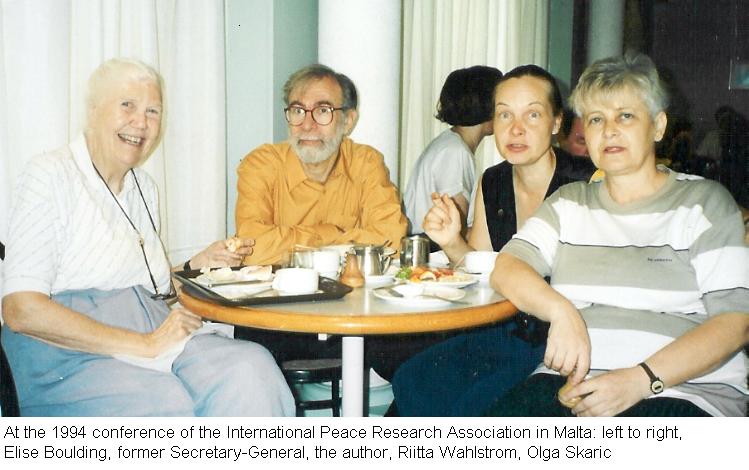
Non-governmental organizations play a key role in the development of the movement. On 17 September 1994, Mr Atherley had addressed the annual DPI/NGO conference in New York. And in 1995 the role of NGOs was emphasized in the chapter on NGOs of the culture of peace monograph. Among the NGOs cited in some detail in the monograph chapter were the World Scout Movement, the International Peace Research Association and the World Council of Churches. Recognizing their importance I undertook missions to involve these organizations in the culture of peace movement in 20 May 1997, 30 October 1994 and 23 June 1998, and 15-16 June 1999, respectively.
The importance of NGOs in the global movement was emphasized in the 20 September 1995 report to the UNESCO General Conference 28 C/123: "The extent of spontaneous activities for a culture of peace by non-governmental organizations confirms the expectation that the culture of peace is becoming a global movement in which every person can find an important role to play. In order to facilitate and inform this global movement, the Culture of Peace Programme is developing an information and networking system."
(continued on next page)
 |
 |
 |