Introduction and UNESCO's Mandate
Page 1
Yamousoukro and Seville Statement
Page 2
Origins and Executive Board Adoption
Pages 3 - 4
Launching the Programme: El Salvador and Roundtable
Pages 5 - 6 - 7
1993 General Conference
Page 8
National Projects
Pages 9 - 10
Programme Unit
Page 11
Toward a Global Scope
Pages 12 - 13
Transdisciplinary Project and Human Right to Peace
Pages 14 - 15 - 16
1997: A New Approach
Page 17
UN General Assembly Resolutions
Page 18
Resolution for International Year
Page 19
Declaration and Programme of Action
Pages 20 - 21
Resolution for International Decade
Pages 22 - 23
Training Programmes
Page 24
Global Movement
Pages 25 - 26
Publicity Campaign
Pages 27 - 28
Decentralized Network
Pages 29 - 30
Manifesto 2000
Page 31
Use of Internet: CPNN
Pages 32 - 33 - 34
Culture of Peace Decade 2001-2010
Pages 35 - 36 - 37
My books about the culture of peace
Page 38
United Nations High-Level Forums on the Culture of Peace
Page 39
The Luanda Biennale: Pan-African Forum for the Culture of Peace
Page 40
Latin American Leadership for the Culture of Peace
Page 41
During the Culture of Peace Decade, when I went with youth advocacy teams to UN headquarters in New York in order to lobby for the Decade reports and the Youth Report, we met each time with Anwarul Chowdhury who had become Under-Secretary General for the Least Developed Countries. He remained committed to the culture of peace as he had been when, as Ambassador from Bangladesh, he headed the Informal Consultations for the adoption of the Declaration and Programme of Action on a Culture of Peace.
Beginning in 2012, Chowdhury undertook a new initiative for the culture of peace, thanks to his extensive contacts in the UN diplomatic community. One of these contacts, the President of the UN General Assembly for 2012, Nassir Abdulaziz Al-Nasser from Qatar, called for a High-Level Forum "an open public opportunity for the UN Member States, UN system entities, civil society including NGOs, media, private sector and all others interested to have an exchange of ideas and suggestions on the ways to build and promote the Culture of Peace." At this first Forum, Secretary-General Ban Ki-Moon stressed that "More than ever, peace requires dialogue across societies, greater sharing among cultures and better communication with others."
At the second High-Level Forum in 2013, Deputy Secretary- General Jan Eliasson said “this is a moment in history when we need a culture of peace – not just the absence of war, but a fully formed culture of peace – so that we can pull together as a single human family to meet our shared challenges.”
At the High-Level Forum of 2014, both Anwarul Chowdhury and Federico Mayor were among the speakers.
Ouided Bouchamaoui, Nobel Peace Prize 2015 Laureate, made the key note address to the High-Level Forum of 2016, highlighting the role of civil society to make our world a better place ensuring peace and justice for all. The civil society took part in an afternoon session chaired by Chowdhury.
Official UN delegations from Europe, Latin America, East Asia, South Asia and the Arab States addressed the High-Level Forum of 2017, although Belgium was the only NATO member to take part.
Nobel Laureate Rigoberto Menchu and Federico Mayor were featured speakers at the High-Level Forum of 2018. Mayor said "I must emphasize the relevance of the culture of peace right now, when we see again supremacism, fanaticism, racism… being widespread without an immediate reaction. . . . We had today here the leading example of Rigoberta Menchú, Nobel Peace Prize 1992. . . . Her speech this morning has been extremely lucid and courageous. Every dawn we must take it into account."
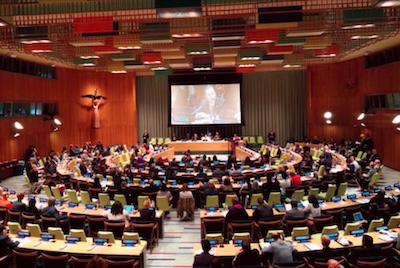
Photo from the 2018 Forum.
The 2019 High-Level Forum was convened by the President of the General Assembly Maria Fernandes Espinoza of Ecuador with the theme “The Culture of Peace: Empowering and Transforming Humanity.”
The High-Level Forum of 2021 was convened and addressed by General Assembly President Vokan Bozkir who pointed out how humanity was brought together by the COVID-1npandemic and stressed the need to “build on this shared sense of grief and anxiety.” In the afternoon Chowdhury moderated a session that included some civil society representatives, including Federico Mayor.
The United Nations did not publish a summary of the High-Level Forum of 2022, but it was described in a press release from Vietnam and statements by the GA President and several UN delegations were available.
My personal relation to the High-Level Forums was problematic. I attended them regularly until 2019 when I went to live in France. Also I took part for several years in Chowdhury's NGO group at the United Nations, which he presumptuously named the Global Movement for a Culture of Peace (GMCOP°. I even wrote a history of the culture of peace that appeared briefly on their website. This may be seen on the Wayback archive of the GMCOP website as of July 25, 2013.. But despite my many meetings of the GMCOP with Chowdhury, he never discussed the Forums with me, let alone invited me to take part.
It became more complicated when Chowdhury objected to the history that I had supplied on the GMCOP website, and demanded that the entire website be removed. For that reason, the only trace remains in the Wayback Archives listed above. Also, Chowdhury began to claim in his many invited speeches and in some articles printed on the Internet, that it was he, and not me and UNESCO that first drafted the Declaration and Programme of Action on a Culture of Peace. I objected to this in numerous emails to him and the GMCOP mailing list, but he never responded.
Since Chowdhury has never responded to me, or to others who have written to him about this matter, I think we can understand his actions as related to his support from the sect Soka Gakkai and its cult leader Daisaku Ikeda.
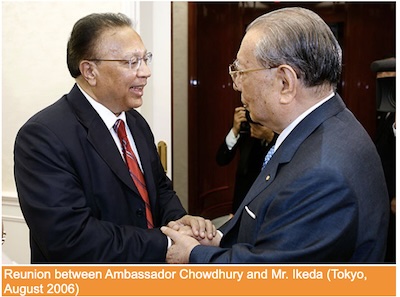
Click on image to go to the book by Anwarul Chowdhury and Daisaku Ikeda.
It seems that Ikeda supported Chowdhury because he expected to receive a Nobel Prize for Peace along with Chowdhury for having written as well as having facilitated the United Nations adoption of the Declaration Programme of Action on a Culture of Peace.
Since Ikeda passed away in 2023, I have not seen any further claims from Chowdhury that he wrote the UN Declaration and Programme of Action, but he has not responded to requests for reconciliation.
Meanwhile, it seems that Chowdhury has lost his influence on the design of the High-Level Forums in a Culture of Peace. Beginning in 2023, the civil society has been excluded from the Forums and only Member States can take part in their official capacity. Chowdhury wrote at that time that the “cold-shoulder” given to the culture of peace for this forum this year is part of a more general rejection of the culture of peace by the current United Nations administration.
 |
 |
 |