Introduction and UNESCO's Mandate
Page 1
Yamousoukro and Seville Statement
Page 2
Origins and Executive Board Adoption
Pages 3 - 4
Launching the Programme: El Salvador and Roundtable
Pages 5 - 6 - 7
1993 General Conference
Page 8
National Projects
Pages 9 - 10
Programme Unit
Page 11
Toward a Global Scope
Pages 12 - 13
Transdisciplinary Project and Human Right to Peace
Pages 14 - 15 - 16
1997: A New Approach
Page 17
UN General Assembly Resolutions
Page 18
Resolution for International Year
Page 19
Declaration and Programme of Action
Pages 20 - 21
Resolution for International Decade
Pages 22 - 23
Training Programmes
Page 24
Global Movement
Pages 25 - 26
Publicity Campaign
Pages 27 - 28
Decentralized Network
Pages 29 - 30
Manifesto 2000
Page 31
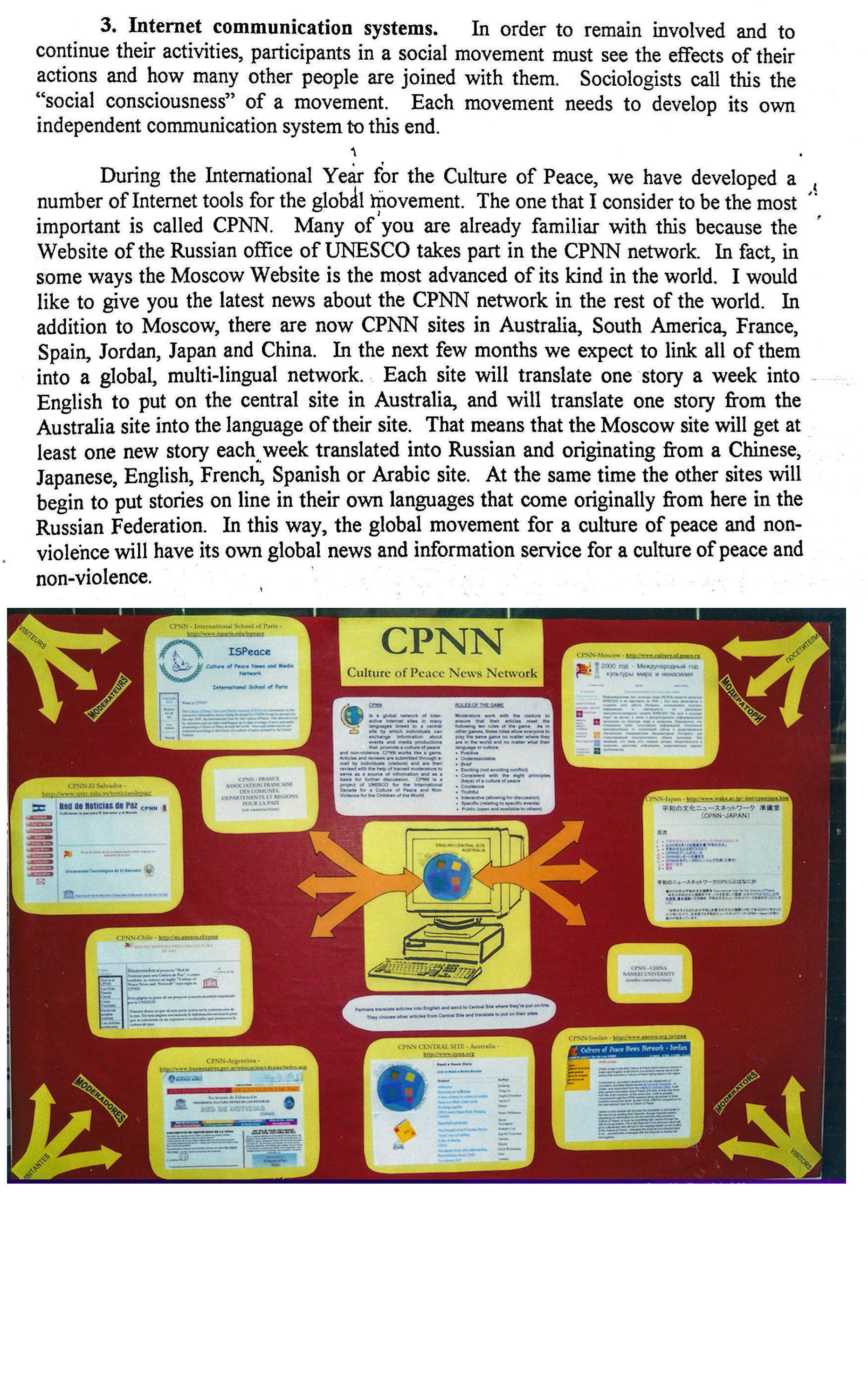
Use of Internet: CPNN
Pages 32 - 33 - 34
Culture of Peace Decade 2001-2010
Pages 35 - 36 - 37
My books about the culture of peace
Page 38
United Nations High-Level Forums on the Culture of Peace
Page 39
The Luanda Biennale: Pan-African Forum for the Culture of Peace
Page 40
Latin American Leadership for the Culture of Peace
Page 41
(continued from previous page)
I had always hoped that the culture of peace news network would become a permanent initiative of UNESCO, and before leaving in 2001, we entered a staffing and budget proposal in the competition for new programs that was launched by the new UNESCO administration and its program director, Hans d'Orville. The proposal, entitled "Moderated information Exchange Network for Peace and Non-Violence" was not accepted. After all, this was the program director who told me that part of his mandate was to get rid of me and to bury the culture of peace program.
The plan for a global network of CPNN was difficult to put into practice after I left UNESCO. For a few years, CPNN websites were maintained by Di Bretherton in Australia, Takehiko Ito in Japan and Ekaterina Saliagina in Moscow. The Australian site, which was expected to be a center for the global network, was supported by a grant from UNESCO. For my part I established a website for the Culture of Peace in New England.
CPNN New England was helped by students in a course that I taught at Wesleyan University in 2002. In particuar, Joe Yannielli and Charlie McNally continued to work with me on CPNN after the course was finished. We published 34 articles in 2002.
In the beginning at CPNNN we tried to establish a network of reporters and moderators, and we also tried to publish a regular list of upcoming events for the culture of peace in New England. However, these attempts were never very successful, and in the long run I ended up being the moderator for all articles.
In 2003, I broadened CPNN as CPNN-USA and we doubled the number of articles to 67, now coming from reports throughout the country and around the world.
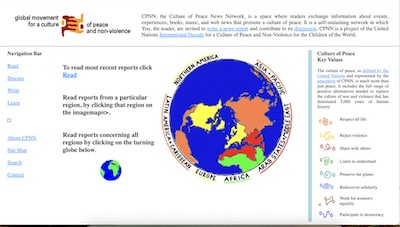
(click on image to go to web archiveof the actual site)
Over the next three years until 2006, we increased our publication rate and many of our readers sent comments which we published on a column to the right of the article concerned. Two readers, Tony Dominski and Helen Raisz, were especially involved at this time, providing many interesting comments.
Two other projects in 2005 and 2006 had an important impact on CPNN, the World Civil Society Report on the Culture of Peace Decade and the report "Youth for a Culture of Peace." Along with teams of youth, including Marcus Estrada, Meg Villanueva, Cécile Barbeito, Oliver Rizzi Carlson and Jo Lofgren, we prepared these reports for Federico Mayor. He financed them from Fundacion Cultura de Paz in Madrid and his tenure as President of the United Nations Alliance of Civilizations. Beginning in 2005 we sent out monthly bulletins in English, French and Spanish from CPNN to mailing lists related to these initiatives as well as an older mailing list that was developed from contributors to CPNN-USA.
In 2007 I made a new format and re-named it as CPNN-World.
When the Decade was completed, the format of the bulletin was changed to become a monthly synopsis of CPNN articles, and it became a permanent feature of CPNN.
In 2010 I founded a small Culture of Peace Corporation with its members being the youth teams with whom I had worked on the reports listed above, along with other youth who had helped with CPNN. The Corporation became the legal owner of CPNN and my other websites and they provided advice for its development.
A proposal from young Corporation members, especially Joe Yanielli, was to shift CPNN from the complex PERL-based system that I had devised previously to a system based on the popular web system, Wordpress. This was a wise decision in 2015, as I learned 10 years later when the bankruptcy of my American Internet provider forced me to shift to a new provider based in Switzerland. The Wordpress files were transferred with only a few problems, but the PERL-based files from 2002 until 2010 had to be completely transformed with several months of intensive work.
Beginning in 2012, I published and distributed a monthly blog in which I was free to express my own opinions about the events that are covered by CPNN.
Over the years I conducted many workshops to train reporters and published their articles on CPNN. Many of these workshops took place at an annual conference at the University of Connecticut that was managed by Amii Omara-Otunnu and Nana Amos. Workshops also took place at several other American universities, as well as in Italy and Mexico. My hopes that most CPNN articles would be written by reporters never fully worked, although for several years Janet Hudgins worked with me in the search for articles about the culture of peace that we could reprint on CPNN.
From 2017 through 2024 I developed and published on CPNN a full description of the events worldwide in celebration of the International Day of Peace. The results of this work, which consumed more than 100 hours of labor each September, are summarized year by year here in Wikipedia
In 2018 CPNN was honored to be nominated for the Nobel Peace Prize by former prize-winners Mikhail Gorbachev and the International Peace Bureaou.
In 2020-2021, I experimented with an added service listing virtual events for the culture of peace prior to their occurrence so that readers could join in. This proved to be very time-consuming but with little evidence of use by our readers so it was not continued.
In 2013 I wrote an article entitled Education for a Culture of Peace: The Culture of Peace News Network as a Case Study for the Journal of Peace Education which describes the state of CPNN at that time. It concluded by stating that the future of CPNN depends upon the development of the Global Movement for a Culture of Peace.
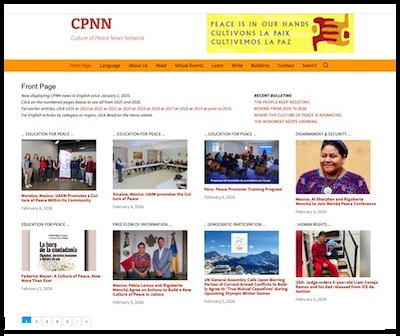
(click on image to go to the actual site)
 |
 |
 |