Introduction and UNESCO's Mandate
Page 1
Yamousoukro and Seville Statement
Page 2
Origins and Executive Board Adoption
Pages 3 - 4
Launching the Programme: El Salvador and Roundtable
Pages 5 - 6 - 7
1993 General Conference
Page 8
National Projects
Pages 9 - 10
Programme Unit
Page 11
Toward a Global Scope
Pages 12 - 13
Transdisciplinary Project and Human Right to Peace
Pages 14 - 15 - 16
1997: A New Approach
Page 17
UN General Assembly Resolutions
Page 18
Resolution for International Year
Page 19
Declaration and Programme of Action
Pages 20 - 21
Resolution for International Decade
Pages 22 - 23
Training Programmes
Page 24
Global Movement
Pages 25 - 26
Publicity Campaign
Pages 27 - 28
Decentralized Network
Pages 29 - 30
Manifesto 2000
Page 31
Use of Internet: CPNN
Pages 32 - 33 - 34
Culture of Peace Decade 2001-2010
Pages 35 - 36 - 37
My books about the culture of peace
Page 38
United Nations High-Level Forums on the Culture of Peace
Page 39
The Luanda Biennale: Pan-African Forum for the Culture of Peace
Page 40
Latin American Leadership for the Culture of Peace
Page 41
(continued from previous page)
Already in 2008 I started preparing for the culture-of-peace, end-of-decade civil society report to the UN. Encouraged by Federico Mayor, I put together an elaborate funding request to involve young people in collecting data and writing the report. But by 2009, Mayor was bankrupt and could not help at all with the compilation of the report.
Speaking in Barcelona in September, 2009, I met three young people whom I had previously worked with, and they asked me about the report. I said "there will be no report because there is no money to pay anyone to work." They replied that it was so important that they would do it without money. I spent a long time with them describing the difficulties that it would entail, but in the end they insisted. So was born the "2010 youth team for the culture of peace." I call them the "third generation" culture of peace activists, and they make me optimistic for the future! The three original members were Cecile Barbeito of the Escole Cultura de Pau in Barcelona, Meg Villanueva of the Philippines and Marcos Estrada of Brazil. I had met Cecile in Santiago de Compostela in 2005 and she had produced the book on best practices for a culture of peace based on the 2005 report. I had met Marcos earlier in 2009 at the Santos Peace Congress where he had come from another distant city on his motorbike. Now he was visiting his sister in Barcelona. Meg had been part of the 2006 youth team at the UN and we had kept in touch. Now she was working for an NGO in Barcelona.
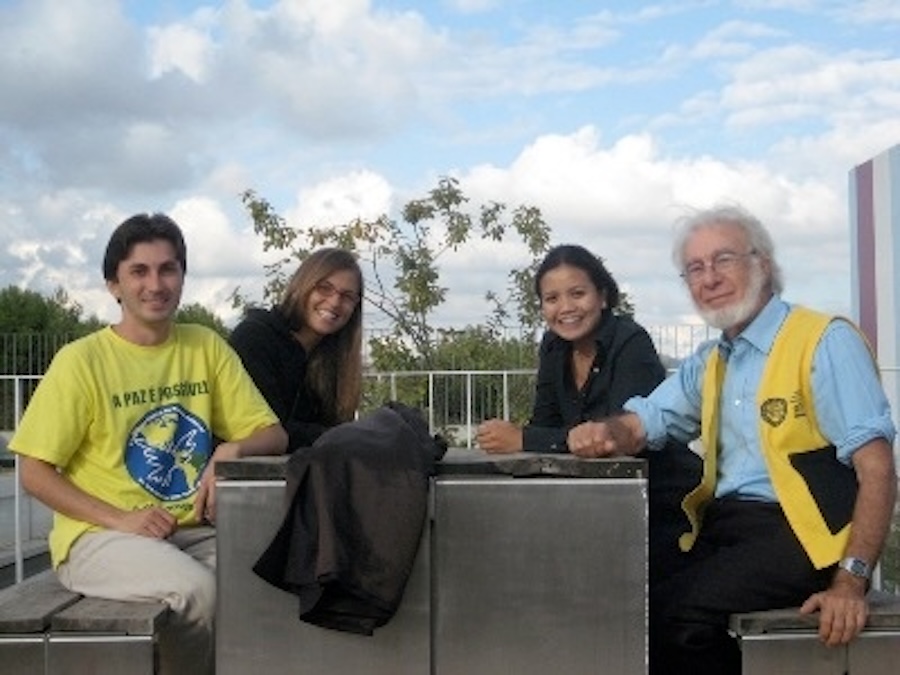
With Marcos Estrada, Cecile Barbeito and Meg Villanueva in Barcelona, September 2009
click on photo to enlarge
The three original members of the youth team began to recruit other youth from around the world through their own networks such as the University of Peace (where Marcos had studied), the Alliance of Civilization Youth Initiative (where Meg had been involved) and the network of NGO activists in Barcelona whom Cecile and Meg knew well. In the end the youth team was joined by Lillian Solheim from Norway and UNOY, Johanna Espina from Colombia getting a degree in Barcelona, Oliver Rizzi Carlson from Switzerland and the Global Campaign for Peace Education, Shreya Jani from Delhi and Standing Together To Enable Peace (STEP), Nikki Delfin from Philippines and the Gaston Z. Ortigas Peace Institute, Himali Jinadasa from Sri Lanka, and Mayte Roitenburd from Mexico working in Barcelona.
I managed the website (see homepage photo below), and the database, while the youth team solicited reports. In the end, when we added the new data to the data from 2005, it came from over 1000 organizations from every part of the world.
Click here for the final report and click here for the data on which it was based.
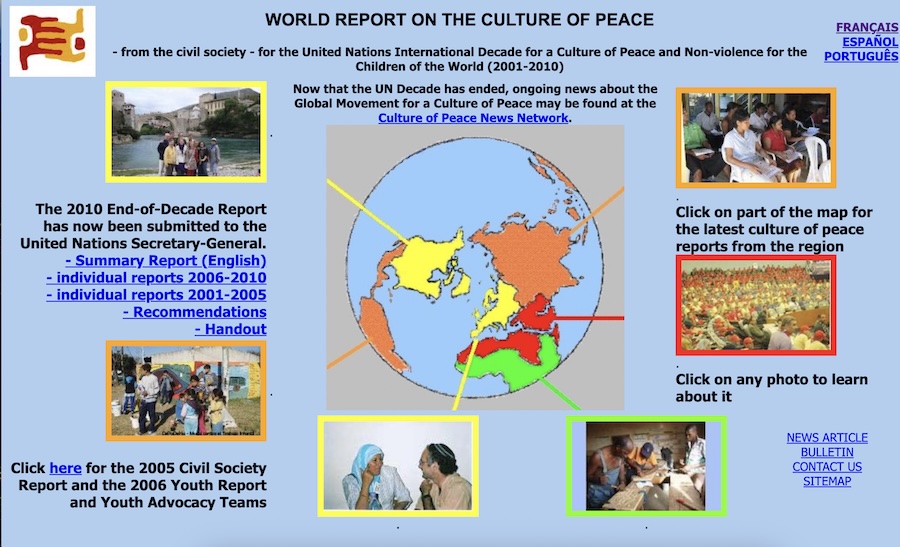
Snapshot of Decade website and its slideshow of photos
click here for the link
The youth team split the work of writing the report, with each taking a different continent, and the result was excellent. Then came the problem of submitting it to the UN, given the problems that we had previously encountered with the 2005 report.
For the most part we had the same problems in 2010 as in 2005. Once again the report was requested in the previous year's General Assembly resolution. But that didn't help. And once again we relied on the Bangladesh mission who was traditionally responsible for culture of peace resolutions, but without much success. Anwarul Chowdhury, who has worked for the culture of peace since the 90's when he was the Ambassador from Bangladesh, worked with me. We met with the new Bangladesh Ambassador who promised to submit the report to the Secretary-General requesting that it be published. And Anwarul Chowdhury obtained the agreement of Ambassaors from a number of other Member States from around the world to support the request. But the Bangladesh Ambassador delayed and delayed to the point that the other countries could not be involved. Then he did not follow up with the Secretary-General so the request was ignored. We got many important organizations to write letters to the Secretary-General requesting the publication, but again to no avail.
Finally, after many months of failure, the Culture of Peace item came up on the floor of the General Assembly. At this point, Federico Mayor helped out. He obtained a meeting with the President of the General Assembly, and I went with Anwarul Chowdhury and Mayor's assistant Manuel Manonelles. Manuel brought with him printed copies of the report. Although the President would not distribute them, we got the help of someone from the Bangladesh mission to distribute them to all of the people attending the debate in the General Assembly Hall, and thanks to Manuel's suggestion, the representative from Spain mentioned it in his speech.
The annual General Assembly resolution on the culture of peace (A/65/11) did include the following brief action paragraph:
"Commends civil society, non-governmental organizations and young people for their activities in further promoting a culture of peace and non-violence, including through their campaign to raise awareness on a culture of peace, and takes note that one thousand and fifty-four organizations from the civil societies of more than one hundred countries have observed the International Decade, as called for in paragraph 13 of resolution 64/80;"
(continued on next page)
 |
 |
 |