Introduction and UNESCO's Mandate
Page 1
Yamousoukro and Seville Statement
Page 2
Origins and Executive Board Adoption
Pages 3 - 4
Launching the Programme: El Salvador and Roundtable
Pages 5 - 6 - 7
1993 General Conference
Page 8
National Projects
Pages 9 - 10
Programme Unit
Page 11
Toward a Global Scope
Pages 12 - 13
Transdisciplinary Project and Human Right to Peace
Pages 14 - 15 - 16
1997: A New Approach
Page 17
UN General Assembly Resolutions
Page 18
Resolution for International Year
Page 19
Declaration and Programme of Action
Pages 20 - 21
Resolution for International Decade
Pages 22 - 23
Training Programmes
Page 24
Global Movement
Pages 25 - 26
Publicity Campaign
Pages 27 - 28
Decentralized Network
Pages 29 - 30
Manifesto 2000
Page 31
Use of Internet: CPNN
Pages 32 - 33 - 34
Culture of Peace Decade 2001-2010
Pages 35 - 36 - 37
My books about the culture of peace
Page 38
United Nations High-Level Forums on the Culture of Peace
Page 39
The Luanda Biennale: Pan-African Forum for the Culture of Peace
Page 40
Latin American Leadership for the Culture of Peace
Page 41
As described here earlier the International Year for a Culture of Peace, the UN General Assembly in 1998 proclaimed the Decade 2001-2010 as the International Decade for a Culture of Peace and Non-Violence for the Children of the world, and in 2000 they put UNESCO in charge of the Decade.
However, by 2004 it had become evident that the new administration of UNESCO would do almost nothing to make the Decade a success.
Federico Mayor agreed to provide me with some funds from his Fundación Cultura de Paz to coordinate a report about civil society initiatives for the Decade to be submitted to the UN General Assembly at for the Decade midterm in 2005.
I developed a questionnaire and sent it out to all of the international organizations that had taken part in the year 2000 mobilization, and I set up a stand and gave out flyers, with the assistance of Kiki and a young man named Gert Danielson, at the World Social Forum in Brazil in January 2005.
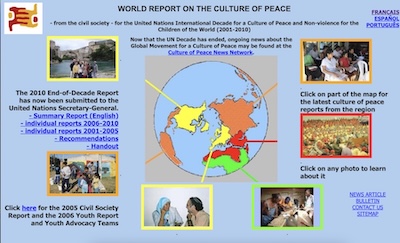
(click on image to go to the actual site)
Most of the funds from Mayor were used for sub-contracts for the mobilization of responses to questionnaires from the various regions:
Latin America, Educating Cities (Alicia Cabezudo) $1,200
Brazil and World Social Forum, Gert Danielsen $300
Caribbean, Proyecto Caribeno de Justicia $2 000
Africa, United Network of Young Peacebuilders $1,000
South Asia, Center of Intl Research
on Human Unity (Gabriel de Gaudenzi) $2,500
Arab States (Bibliotheca Alexandrina) $ 3,300, including for translations
The greatest amount of work, however, was done by myself, especially with regard to international organizations, many of whom had to be requested by telephone and email up to 10 times before we got their information.
People tended to wait until the last possible moment to respond. I had set a May 1 deadline and as of April 1 there were only a few more than 100 responses. Most of the 700 responses came in the last few weeks.
As you can see here, the 700 midterm reports come from organizations everywhere in the world and involved thousands, perhaps millions, of people working for a culture of peace.
We had expected that the UN Secretary-General would follow the instructions of the resolution quoted above and would forward the report to the General Assembly and have it published in the six UN languages. But as I describe in some detail elsewhere, this did not happen and we had to take other measures to disseminate the report, including the Youth Advocacy Team that made appointments with ambassadors and gave it to them personally.
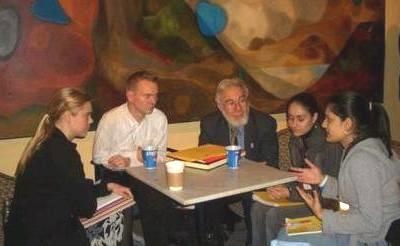
(click on image to go to their report)
Using funds from Barcelona, the Barcelona region and Catalunyan governments, Mayor's Fundación printed up books with the final report and related documents which I mailed to all of the 700 participating organizations, and which we have been distributing since then. These books are available on the Internet by way of links on the Decade website.
(continued on next page)
 |
 |
 |