Introduction and UNESCO's Mandate
Page 1
Yamousoukro and Seville Statement
Page 2
Origins and Executive Board Adoption
Pages 3 - 4
Launching the Programme: El Salvador and Roundtable
Pages 5 - 6 - 7
1993 General Conference
Page 8
National Projects
Pages 9 - 10
Programme Unit
Page 11
Toward a Global Scope
Pages 12 - 13
Transdisciplinary Project and Human Right to Peace
Pages 14 - 15 - 16
1997: A New Approach
Page 17
UN General Assembly Resolutions
Page 18
Resolution for International Year
Page 19
Declaration and Programme of Action
Pages 20 - 21
Resolution for International Decade
Pages 22 - 23
Training Programmes
Page 24
Global Movement
Pages 25 - 26
Publicity Campaign
Pages 27 - 28
Decentralized Network
Pages 29 - 30
Manifesto 2000
Page 31
Use of Internet: CPNN
Pages 32 - 33 - 34
Culture of Peace Decade 2001-2010
Pages 35 - 36 - 37
My books about the culture of peace
Page 38
United Nations High-Level Forums on the Culture of Peace
Page 39
The Luanda Biennale: Pan-African Forum for the Culture of Peace
Page 40
Latin American Leadership for the Culture of Peace
Page 41
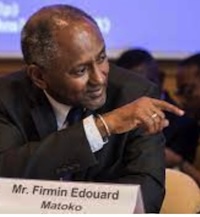
In 2019 two of my closest comrades from the years with Federico Mayor at UNESCO were engaged with Africa. Firmin Edouard Matoko was the head of Priority Africa at UNESCO headquarters and Enzo Fazzino was the regional representative of UNESCO based in Gabon.
Thanks to their network of connections, especially the Angolan ambassador to UNESCO, Diekumpuna Sita José, they were able to get the agreement of UNESCO, the African Union and the Government of Angola to launch a biennial celebration of the culture of peace in the Angolan capital of Luanda.
 - - -
- - - 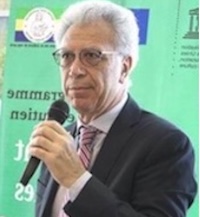
Edouard (Firmin) Matoko and Enzo Fazzino
The decision for the Biennale was preceded by the “Pan African Forum on the Sources and Resources for a Culture of Peace” convened in Luanda by the government of Angola and UNESCO in March 2013 and a second international conference , again in Luanda in December 2016.
The agreement to establish the forums on a regular biennial basis was signed by Edouard Matoko on behalf of UNESCO in December 2018 and the official announcement was made in February at a ceremony where UNESCO was represented by Enzo Fazzino.
The first Luanda Biennale was held September 18-22, 2019, and addressed by UNESCO Director-General Audrey Azoulay. It included a Partners’ Forum, Alliance for Africa, a Forum of Ideas and a Festival of Cultures.
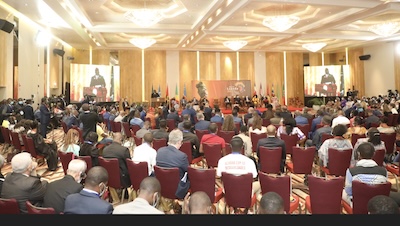
Click on image to go to an article about the Biennale of 2021
The most successful Biennale took place 27 November to 2 December 2021. Speakers included UNESCO Director-General Audrey Azoulay, African Union President Félix Tshisekedi and the President of Angola João G. Lourenço. 180 participants on the opening day included representatives of ICESCO, the Regional Economic Commissions (RECs), technical and financial partners as well as representatives of the United Nations system from over 60 countries. 120 Young Leaders participated from all African countries and representatives of the Diaspora, of which 9 were present in Luanda and the others virtually. The full programme is available here.
The 2021 Biennale featured a Festival of Cultures with 44 countries represented in Virtual Pavilions showcasing rich content on cultural diversity and examples of national initiatives, as well as partners and associated personalities. It included a rich selection of films and shows on the themes of the culture of peace.
The 2021 Biennale was organized in a new and unique format with an Intergenerational Dialogue by which youth from Africa and the Diaspora debated with Ministers of Youth and Culture on the importance of cultural and heritage diversity of Africa and its Diasporas to promote the culture of peace in the continent.
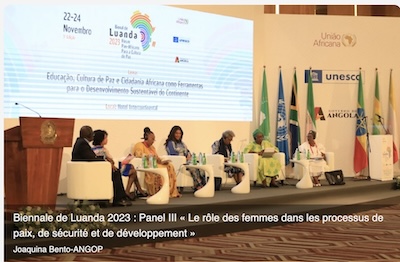
Click on image to go to an article about the Biennale of 2023
The Biennale of 2023 brought together 790 participants from different African countries in a hybrid format, combining face-to-face and virtual events. It advocated the establishment of partnerships between political leaders and young people, in sustainable social and economic projects, which could benefit society as a whole. Its second day was devoted to the role of women in peace processes. Again, many young Africans testified that they will carry forward the message of a culture of peace.
A Bienalle for 2025 was proposed by the African Union in their assembly of February 2024, but for reasons that have never been explained, the Forum did not take place.
 |
 |
 |