Introduction and UNESCO's Mandate
Page 1
Yamousoukro and Seville Statement
Page 2
Origins and Executive Board Adoption
Pages 3 - 4
Launching the Programme: El Salvador and Roundtable
Pages 5 - 6 - 7
1993 General Conference
Page 8
National Projects
Pages 9 - 10
Programme Unit
Page 11
Toward a Global Scope
Pages 12 - 13
Transdisciplinary Project and Human Right to Peace
Pages 14 - 15 - 16
1997: A New Approach
Page 17
UN General Assembly Resolutions
Page 18
Resolution for International Year
Page 19
Declaration and Programme of Action
Pages 20 - 21
Resolution for International Decade
Pages 22 - 23
Training Programmes
Page 24
Global Movement
Pages 25 - 26
Publicity Campaign
Pages 27 - 28
Decentralized Network
Pages 29 - 30
Manifesto 2000
Page 31
Use of Internet: CPNN
Pages 32 - 33 - 34
Culture of Peace Decade 2001-2010
Pages 35 - 36 - 37
My books about the culture of peace
Page 38
United Nations High-Level Forums on the Culture of Peace
Page 39
The Luanda Biennale: Pan-African Forum for the Culture of Peace
Page 40
Latin American Leadership for the Culture of Peace
Page 41
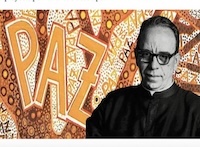
From the very beginning of the culture of peace Latin America played a leading role.
Father Felipe MacGregor (photo left) brought the concept from Peru to the 1989 Yamoussoukro conference with his book Cultura de Paz published in 1986. From Yamoussoukro the concept was adopted by UNESCO.
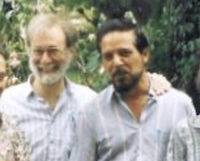
UNESCO's first national programme for a Culture of Peace took place in El Salvador beginning in 1993. It was managed for UNESCO by Francisco Lacayo of Nicaragua (shown on the right with me at a planning meeting for the project), who also made important contributions to the strategy for the development of a global movement for the culture of peace.
The first resolution for a culture of peace at the UN General Assembly was introduced by Peru in 1995.
The initial call for a United Nations International Year for the Culture of Peace came from Latin American publishers meeting in Puebla, Mexico, in 1997.
During the International Year for the Culture of Peace in 2000, there were 15 million signatures in Brazil and 11 million in Colombia (more than 25% of the population of Colombia).
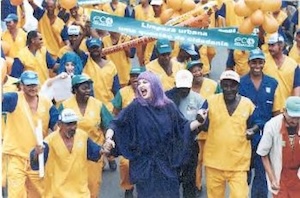
During the International Decade for a Culture of Peace and Non-Violence for the Children of the World (2001-2010), there was participation by 78 organizations in Brazil alone by the time of the midterm, with 12 more becoming active in the second half of the Decade. The Brazilian participation was facilitated by Gert Danielsen whom we sent to work with the Office of UNESCO in Brasilia, thanks to funding from Federico Mayor. In Argentina there were 40 organizations and in Colombia 20. Shown above is one of the photos supplied to the report by the NGO Eco-Cidade of Brazil. Click on the photo to see their report.
Of particular importance during the Decade was the establishment of official City Peace Commissions in many cities of Brazil, including Sao Paulo, Curitiba, Londrina and Santos. The initiatives were inspired by Helena Lourenço of the NGO Abrasoffa in Santos and by Lia Diskin in the other cities.
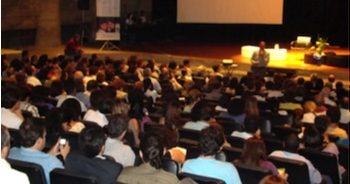
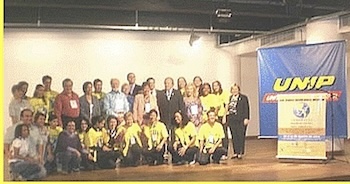
I was privileged to be invited to Sao Paulo, Brazil, by Lia Diskin where I met with her organization and others that were promoting the Culture of Peace Decade. I was also privileged to be invited to Santos, Brazil by Helena Lourenço where I met with the mayor promoting a city peace commission and took part in conference organized by Helena for the culture of peace. On the left above is a photo from the meeting in Sao Paulo and on the right from the meeting in Santos. Click on the image to go to the articles concerned in CPNN.
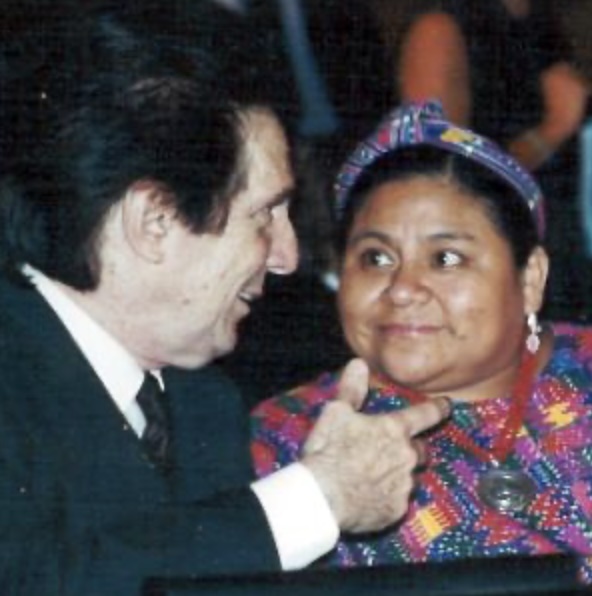 Over the years, the culture of peace has been consistently and effectively promoted by two Nobel Peace Laureates from Latin America, Adolfo Perez Esquivel from Argentina and Rigoberto Menchu Tum from Guatemamla. Here is a peace appeal by Esquivel in 2026. Here is a project for the culture of peace in Mexico in 2026 by Rigoberto Menchu. On the right is a photo of them when they came to the launch of the International Year for the Culture of Peace in Paris in 1999 (click on image to enlarge).
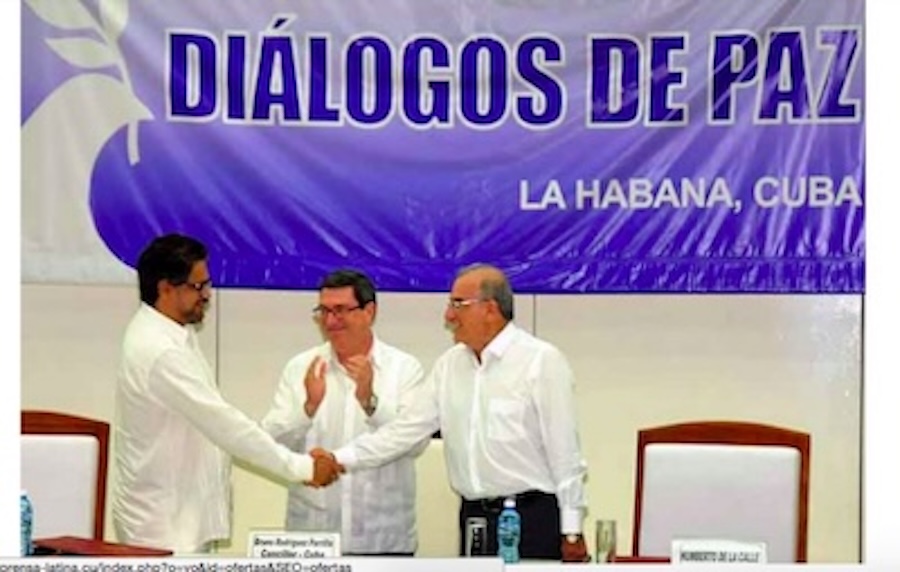
Perhaps the most inspiring initiatives for a culture of peace in recent years has been the peace process in Colombia. We have followed this closely on the Culture of Peace News Network with more than 100 articles from 2015 through 2025. Given its own history of resisting North American imperialism, it is especially appropriate that the peace process was mediated by Cuba (see photo above).
Another Latin American country that had been forced to resist North American imperialism is Mexico. Like Colombia, Mexico is torn by violence from drug cartels that profit from their sales to the United States. Although the US government claims to oppose the drug trade, its history tells another story: it was the agencies of the US government that ran the opium drug trade from Laos during the Vietnam War, the cocaine trade from Latin America during the Contra War against Nicaragua and (probably) the opium trade during their war in Afghanistan.
In the face of the violence of the drug trade, Mexico has turned over the years to working for the culture of peace. We have followed this closely on the Culture of Peace News Network with more than 80 articles from 2015 through 2025. Government agencies, universities and schools throughout the country are constantly engaged in training programs for the culture of peace. One of them is mentioned above involving Nobel Peace Laureate Rigoberto Menchu.
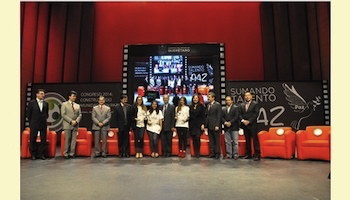
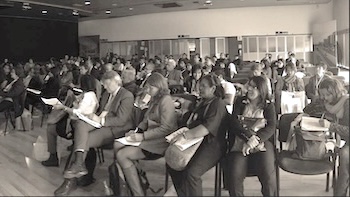
In 2015 I was privileged to take part in culture of peace meetings in
Queretero, Mexico and Bogotá, Colombia Photos of these meetings are shown above. Click on the photo to go to the article concerned. The meeting in Queretero, entitled ""Building Communities in Peace" was attended by government officials, NGO's and media personalities. The meeting in Bogotá was a "National Conference on Education for Peace", attended by educators and students.
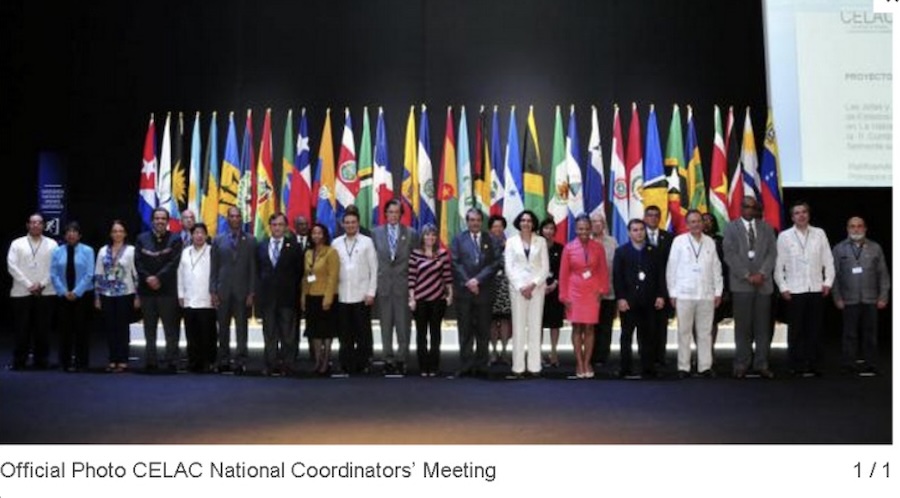
The Heads of State and Government of the Community of Latin American and Caribbean States (CELAC), gathered in Havana, Cuba in January 2014, issued a Proclamation declaring their region a zone of peace and committing to "the promotion in the region of a culture of peace based, inter alia, on the principles of the United Nations Declaration on a Culture of Peace." (see photo above - click on it to enlarge)
Repeatedly during the years that we have issued monthly bulletins from CPNN summarizing the most important news for the culture of peace, the subject has been the culture of peace in Latin America. Here is a list:
° 2012: July: Rio Summit
° 2013: February: Focus on Latin America
° 2014 March: Latin America and the Caribbean at the forefront; May: Towards peace in Colombia
° 2015 September: Colombia prepares for peace: November: Culture of Peace in Latin America
° 2016 July: Peace in Colombia
° 2017 September: Visit to Latin America
° 2019 March: What is happening in Venezuela?
° 2021 January: Culture of Peace in Mexico
° 2022 February: Mediation and Restorative Justice in Latin America; July: Colombia and Nuclear Disarmament; August: Culture of Peace in Latin America
° 2023 January: Latin America and Africa; June: Latin America and Africa: Continuing Leadership
° 2024 January: Good news from Latin America; December: A tale of two summits
° 2025 January: Peace advances in Africa, Latin America; August: The Global South as an alternative
 |
 |
 |